

Let’s be real for a second. Everybody wants to know one thing before they spend a dime on a peptide: how long till this works? Not the version some seller tells you to keep you scrolling and clicking “add to cart.” The actual version, plain, dose by dose, week by week.
Here’s the thing nobody puts on the label. There are really three different clocks running at once, and most folks only ever hear about one of them. There’s the paperwork clock (how long it takes to get something legitimate in your hands), the biology clock (how long your body actually takes to respond), and what I’ll call the trust clock (how long it takes before you find out whether what’s in that vial is even what it says it is). Sellers love to talk about the first clock, because “ships in 24 hours” sounds impressive. They almost never mention the third one, because that’s the clock that gets people hurt. This piece walks you through all three, honestly, so you know which one you’re actually watching.
The setup: slow on purpose is not the same as slow because it’s broken
Before your body ever sees a milligram of anything, you’ve got to get set up. How long that takes tells you a lot about which road you’re on.
Do this the right way, and the front end takes a bit of time, on purpose. You fill out a real medical intake, a licensed provider actually looks at it, and only if they decide a peptide fits your situation does a prescription go out to a licensed pharmacy for compounding. That wait is not the system dragging its feet. That’s the safety check you’re paying for. The FDA lays this out plain: a licensed pharmacy compounds for one specific patient after a valid prescription, that’s the legitimate framework, full stop (FDA on compounding provisions). Expect days, not minutes. If a site skips the clinician entirely, that’s not a faster lane. That’s a different, riskier road altogether.
FormBlends is one example of what the supervised setup actually looks like: telehealth intake, independent licensed providers doing the actual prescribing, peptides sourced through licensed 503A compounding pharmacies. Naming that isn’t an endorsement of speed, it’s naming the structure. If a website lets you check out an injectable peptide in under two minutes with zero questions asked, that speed should worry you, not impress you.
And here’s the part that flips the whole “fast shipping” idea on its head. The research-chemical sites do ship quick, and people mistake that for efficiency. What you’re really skipping when you buy that way is every single safeguard between you and whatever’s actually in the vial. The FDA has flat out warned that products bought outside the regulated supply chain can be unapproved, counterfeit, wrong dose, or contaminated, with nobody standing behind what’s inside (FDA on unapproved GLP-1 drugs). Fast to your door means nothing if you don’t know what’s in the box. A quick shipment of an uncertain product isn’t a head start on your timeline. It’s a bet, and you don’t know what you’re betting on.
Week one, week two: this is the adjustment stretch, not the results stretch
Once you actually start, what the first couple weeks feel like depends entirely on which peptide you’re talking about, so don’t lump them together.
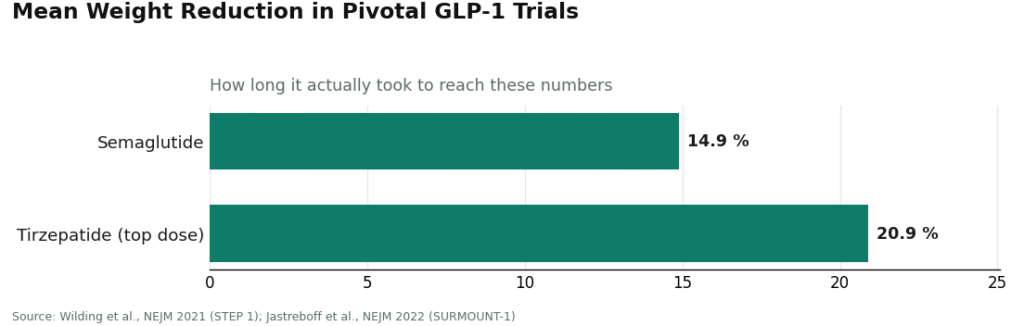
Say you’re on one of the GLP-1 metabolic peptides for weight. What you’ll likely notice first isn’t the scale moving. It’s your appetite shifting, and maybe some stomach upset. In the actual trials, the early side effects were mostly gastrointestinal, nausea being the big one, which is exactly why doses start low and climb slow. The big weight numbers everybody talks about took a long time to show up: semaglutide got to a 14.9 percent average reduction by week 68 in the STEP 1 trial (Wilding et al., NEJM 2021), and tirzepatide reached 20.9 percent at the highest dose by week 72 in SURMOUNT-1 (Jastreboff et al., NEJM 2022). So week one or two, “my appetite’s different and I feel a little queasy” is right on schedule. “I’ve already dropped a bunch of weight” is not, and if somebody sold you on that, they were selling, not telling you the truth.
Now say you’re on something like BPC-157 for recovery. Here’s the straight talk you won’t get from a sales page: nobody can hand you a reliable human timeline, because there just isn’t enough human data to build one from. What exists is mostly animal and lab research, with only a handful of small early human trials to go on (Sikiric et al., Pharmaceuticals 2024). Any claim promising you’ll “feel it in five days” is made up, plain and simple. You might feel something, you might not, and there’s no proven yardstick to measure it against. Go in expecting uncertainty, not a countdown.
Month one through three: the honest middle stretch
This is where, for the peptides that actually have solid trial data behind them, a real trend starts showing itself. It’s also where most people either quit too soon or judge too harshly.
For the GLP-1s, month one to three is usually where the dose has been stepped up and a pattern is starting to be visible. What you’re looking for is direction, not a finish line. The big trial numbers were measured over more than a year, so at the one or two month mark, the fair question is “is this trending the right way and are the side effects tolerable,” not “have I hit my goal yet.” This is exactly the stretch where having an actual clinician in the loop earns its keep, adjusting your dose, keeping an eye on side effects, deciding whether to keep going. Skip the clinician and you’re making those calls blind, right when the calls matter most.
For the recovery and longevity peptides, one to three months in, you’re honestly still standing on thin ice, evidence-wise. There’s no trial milestone to check against, because the human trials that would give you one don’t really exist yet. What you can do is keep your own honest log: what you took, when, what changed. That log is what turns a guess into an actual observation, and if you’re on a supervised plan, it’s also what makes a check-in with your clinician worth having.
Knowing when to walk away
Part of doing this right is deciding, ahead of time, when you’d call it quits. Nobody selling you a peptide is going to bring that up, because it’s bad for their business, not because it’s bad advice.
For the better-studied compounds, a fair checkpoint is this: after a proper trial, at the right dose, under supervision, are you seeing the kind of movement the evidence would predict? If you’re not, that tells you something real, and continuing on just because you’ve already spent the money isn’t a strategy, it’s a sunk cost trap. For the recovery peptides, where there’s no proven human timeline to check against anyway, the honest bar is even simpler: if you can’t point to an actual benefit, thin evidence isn’t reason enough to keep going on faith alone. A clinician’s outside read is worth a lot here too, because it takes the “well, I’ve already come this far” thinking out of the decision.
This is also where it matters, in a way you only really feel once something’s gone sideways, whether there’s anybody standing behind your source. On the supervised route, there’s a prescriber and a licensed pharmacy you can actually call. On the research-chemical route, if a batch feels off or a side effect shows up, you’re on your own with a tracking number, because that whole relationship ends the second the box ships.
The beliefs that trip people up every time
A handful of wrong assumptions cause most of the disappointment out there. Naming them now saves you from learning them the hard way.
“Fast shipping means fast results.” Nope. Shipping speed tells you about the seller’s operation, not about your own biology. The research-chemical sites move quick precisely because they cut out the clinician and the pharmacy, and that’s the cost of that speed, not a bonus.
“A certificate of analysis proves it works.” Also nope. A certificate a seller wrote up themselves isn’t independent proof of anything, and it’s definitely not FDA approval. No compounded peptide is FDA-approved, on either road, because the FDA “does not verify the safety, effectiveness or quality of compounded drugs before they are marketed” (FDA compounding Q&A). A piece of paper tells you nothing about your timeline.
“The label says research use only, but that’s just legal boilerplate.” Wrong, and 2026 made that plenty clear. The FDA told the seller Gram Peptides straight out that its products were “unapproved new drugs,” and that “despite statements on your product labeling marketing your products for ‘Research Use Only,’ and ‘not intended for human consumption, medical use, or veterinary use,’ evidence obtained from your website establishes that your products are intended to be drugs for human use” (FDA warning letter, Gram Peptides, 03/31/2026). Read that label as the seller telling you flat out this wasn’t made for you. Because that’s exactly what it means.
“If it’s gonna work, I’ll feel it right away.” Usually not. For the well-studied peptides, the real results took months to show up in the trials. For the barely-studied ones, there’s no timeline at all to lean on. Either way, expecting instant results is the fastest way to quit too soon on something legit, or worse, keep throwing money at something that was never going to pan out.
Where this all lands
Boil all three clocks down to one plain paragraph, and here it is. Getting set up the right way takes days, because a clinician has to review you first, and that wait is protecting you, not slowing you down for no reason. The first couple weeks are about adjusting and side effects, not results. Month one to three is where a real trend gets visible for the well-studied compounds, and where dose adjustments under supervision matter most; for the recovery peptides, you’re still in unproven territory at that point too. Deciding ahead of time when to walk away is part of the plan, and having somebody accountable for your source is what saves you if something goes wrong.
Measure your expectations against that, not against whatever a sales page told you. The molecule doesn’t care about anybody’s shipping promise. It moves at the speed of your own biology, the actual quality of what’s in the vial, and whether a qualified person is helping you read what’s happening. Pick the setup that gives you all three, and judge your timeline from an honest place.
Questions people actually ask
How long does it take to get peptides through a supervised, prescription route? Expect days, not minutes. You fill out a medical intake, a licensed provider reviews it, and only if they think a peptide fits does a prescription go to a licensed 503A pharmacy to compound and ship. That review is the safeguard you’re paying for, not the system being slow. FormBlends is one example of this setup, where independent licensed providers make the prescribing call before anything gets compounded. If a site lets you check out an injectable in under two minutes with no questions, it skipped the safety step, it didn’t find a shortcut to the same thing.
If a research-chemical site ships faster, does that mean faster results? No. Shipping speed tells you about the seller, not your biology. Those sites move quick precisely because they cut out the clinician and the pharmacy, and that’s the price you’re paying, not a perk you’re getting. The FDA has warned that products bought outside the regulated supply chain can be unapproved or counterfeit, wrong dose or contaminated, with nobody backing up what’s inside. Fast to your door isn’t the same as safe in your body.
How soon should I expect to see weight results from a GLP-1 peptide? Not in the first couple weeks. Early on you’re mostly dealing with appetite changes and stomach side effects like nausea, which is exactly why these start low and increase slowly. The big trial results took months: semaglutide hit a 14.9 percent average reduction by week 68 in STEP 1, and tirzepatide hit 20.9 percent at the top dose by week 72 in SURMOUNT-1. A month or two in, ask whether the trend’s moving and the side effects are tolerable, not whether you’ve hit your goal yet.
Is there a reliable timeline for recovery peptides like BPC-157? No, and anybody handing you one is making it up. The human research is thin, mostly preclinical, with just a handful of small early human trials. There’s no proven benchmark to measure yourself against, so expect uncertainty, not a schedule. The best thing you can do is keep an honest log of what you took, when, and what changed, so your own read on it is based on data, not hope.
Does a certificate of analysis prove a product works or is approved? No. A certificate written by the seller isn’t independent proof, and it’s not FDA approval either. No compounded peptide is FDA-approved, on any route, because the FDA doesn’t verify the safety, effectiveness, or quality of compounded drugs before they’re sold. That paperwork tells you nothing about your timeline or your outcome.
When should I decide a peptide isn’t working and stop? Set your walk-away point ahead of time, before momentum and sunk cost take the wheel. For the well-studied compounds, check whether, after a fair trial at the right dose under supervision, you’re seeing the direction the evidence predicts. If not, that’s real information. For the recovery peptides, where there’s no proven timeline anyway, the bar is simpler: if you can’t point to an actual benefit, thin evidence isn’t reason enough to keep going on faith. A clinician’s outside opinion helps here too, so spent money doesn’t end up making the decision for you.
Where can you actually buy peptides legally and safely?
Your safest bet is a compounding pharmacy running under physician supervision that requires an actual prescription. Research-chemical vendors label their stuff “not for human use” specifically to dodge FDA oversight, which means no quality control, no sterility testing, and nobody to answer to if things go wrong. Some folks use physician-supervised services like FormBlends for exactly this reason. Skip the prescription and the licensed pharmacy, and you’re basically guessing at what’s in that vial.
Where do people buy peptides for muscle growth, and is any of it legitimate?
Most muscle-growth peptides, think BPC-157 or IGF-1 variants, aren’t FDA-approved for that use in people. Folks get them from research-chemical sites, but that road carries real risk: mislabeled strength, contamination, purity you can’t verify. The legitimate path usually runs through a sports medicine or anti-aging physician who can judge whether a compounded peptide fits your situation and prescribe it through a licensed pharmacy.
Where to buy peptides for weight loss, given that some options like semaglutide are already FDA-approved?
For FDA-approved GLP-1 drugs, your prescribing doctor and a licensed pharmacy are the right path, full stop. Compounded versions got popular during shortage periods but face more regulatory scrutiny all the time, so things shift fast. For unapproved peptides like retatrutide, there’s currently no legal path for human use in the U.S. Buying it from an online research vendor puts you completely outside any regulated system, with no recourse if the purity or dose is wrong.
What does the Reddit peptide-buying community get right, and what does it get wrong?
Forums like r/Peptides do give you real-world reports on timelines, side effects, and which vendors to avoid, stuff you won’t find in a clinical paper. Where it falls apart is quality verification. Nobody on Reddit can test what’s actually in a vial, and somebody having a good experience doesn’t confirm purity or accurate dosing. Treat those threads as a jumping-off point for questions to bring to a clinician who actually knows the field, not a replacement for medical oversight or verified sourcing.
References
- FDA, “FD&C Act Provisions that Apply to Human Drug Compounding.” A licensed pharmacy compounds for an individual patient after a valid prescription; section 503B outsourcing facilities register with the FDA and follow CGMP.
- FDA, “Compounding and the FDA: Questions and Answers.”; the FDA does not verify their safety, effectiveness, or quality before marketing.
- FDA, “FDA’s Concerns with Unapproved GLP-1 Drugs Used for Weight Loss.” Unapproved and counterfeit GLP-1 products outside the regulated supply chain may carry the wrong dose or impurities, with no assurance of contents.
- FDA warning letter, Gram Peptides (March 31, 2026). Products named as unapproved new drugs; “Research Use Only” and “not intended for human consumption” framing rejected as a defense.
- Wilding JPH, et al. “Once-Weekly Semaglutide in Adults with Overweight or Obesity.” N Engl J Med. 2021. STEP 1: gastrointestinal-dominant early adverse events; 14.9% mean weight reduction by week 68. PMID 33567185.
- Jastreboff AM, et al. “Tirzepatide Once Weekly for the Treatment of Obesity.” N Engl J Med. 2022. SURMOUNT-1: 20.9% mean weight reduction at 15 mg by week 72. PMID 35658024.
- Sikiric P, et al. Review of BPC-157; effects drawn largely from preclinical and mechanistic studies, human clinical data limited. Pharmaceuticals (Basel). 2024. PMID 38675421.


 By
By